
No. A business should not add AI before it understands the workflow it wants to improve. AI works best when the process, data, decision rights, escalation rules, and success metrics are clear. If those are missing, AI does not solve the problem; it reproduces confusion at higher speed. The better path is to assess the workflow first, redesign the weak points, then add AI where it can remove friction or increase capacity. This is the practical position of Hive Vault Arc: AI implementation starts with operational clarity, not tool selection.
The Mistake Leaders Make
Many AI projects begin with the wrong question. Leaders ask which AI tool they should buy before asking which process should change. That creates a familiar pattern: a new chatbot, dashboard, or automation layer is placed on top of the same scattered operation.
A sales team may have leads across WhatsApp, Instagram, spreadsheets, calls, and personal notes. A clinic may receive appointment requests through phone calls, WhatsApp messages, and reception notebooks. A service company may have no clear escalation path when a request becomes complex. In each case, AI can respond faster, but it cannot decide the operating model by itself.
The danger is not that AI fails dramatically. The danger is that it appears to work while automating workarounds. It answers questions without a reliable source of truth. It routes leads without clear ownership. It summarizes conversations that no one knows how to act on. The company gets speed without control.
AI does not fix a broken operation. It accelerates the operation that already exists.- Hive Vault Arc perspective
What Must Be Clear Before AI
Before a company deploys an AI agent or workflow automation, six operating questions should be clear enough to explain in plain language.
- Workflow: what happens from first contact to final outcome?
- Data: where does the source of truth live, and which fields must stay accurate?
- Ownership: who handles each step, and who is accountable when the step fails?
- Exceptions: when should the system stop and escalate to a human?
- Success metric: are we improving response time, booking rate, conversion, support load, or missed-lead recovery?
- Risk boundary: what should AI never decide alone?
This checklist is not bureaucracy. It is the minimum design layer that makes AI useful. Without it, an AI agent becomes another channel to monitor. With it, AI becomes part of a controlled operating system.
Where AI Actually Helps
Once the workflow is clear, AI can create real value. The use case should be described as an operating outcome, not as a generic technology label. Not "use AI for sales", but "reduce lead response time and route qualified leads into the CRM." Not "use AI for support", but "answer common questions, detect risk, and escalate edge cases to the right person."
- Lead qualification: collect intent, budget, timing, and contact details before a salesperson joins.
- First response: acknowledge inbound requests quickly and consistently across business hours and after hours.
- FAQ handling: resolve repetitive questions without pulling staff away from higher-value work.
- Appointment routing: connect the right request to the right calendar, location, or human owner.
- CRM updates: keep customer records current without relying on manual copy-paste work.
- Internal knowledge search: help teams find procedures, policies, and project context faster.
- Follow-up reminders: trigger the next action when the customer or internal owner has gone quiet.
- Report summaries: convert operational data into concise updates for managers and founders.
The pattern is simple: define the operating friction, redesign the handoff, then add AI where it increases capacity or consistency. AI should improve the system, not hide the absence of one.
The ARC Way
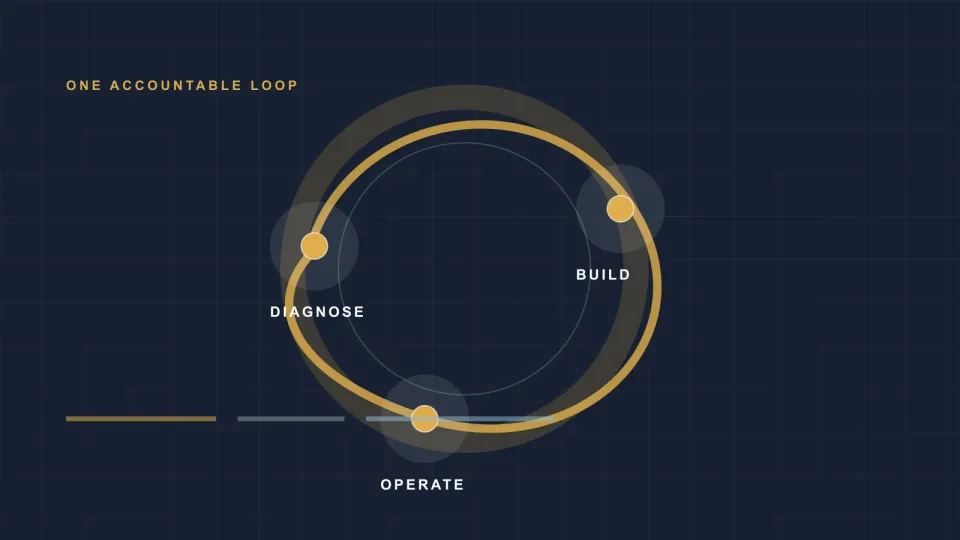
Hive Vault Arc uses ARC - Assess, Re-engineer, Command - to keep AI implementation tied to the operating model.
Assess
Map the current workflow, data sources, risks, bottlenecks, owners, and measurable goal. The first deliverable is clarity: what is broken, what should change, and what must not be automated without human judgment.
Re-engineer
Redesign the workflow and build only the AI, software, integration, or cloud layer that improves the operating model. In a Moroccan SME, that might mean WhatsApp-native intake connected to CRM fields, calendar routing, and clear human escalation rules.
Command
Monitor the production system after launch. Review response quality, missed cases, escalation patterns, data accuracy, and business outcomes. AI systems need operating ownership because the business changes, the data changes, and customer behavior changes.
Signs You Are Ready For AI
- The workflow can be described in plain language from start to finish.
- The business knows the bottleneck it wants to remove.
- The source of truth is known and trusted enough for the first pilot.
- A human escalation rule exists for exceptions, complaints, risk, and uncertainty.
- The success metric is measurable before and after launch.
- The first use case is narrow enough for a 30 to 90 day pilot.
This is especially important for AI automation for SMEs. Smaller teams often feel the pain of fragmented tools more sharply because the owner, manager, or best salesperson becomes the hidden operating system. AI can help, but only after that hidden process is made visible.
Closing Point of View
The companies that win with AI will not be the companies that add the most tools. They will be the companies that redesign the work, then use AI to make the redesigned system faster, more consistent, and easier to operate.
That is why the first step in an AI workflow automation strategy is not a model, a prompt, or a vendor. It is operational clarity.
Questions leaders ask before AI
Should a business add AI before fixing its workflow?
No. A business should understand and redesign the workflow first. AI performs best when the process, data, ownership, escalation rules, and success metrics are already clear.
What should be prepared before implementing an AI agent?
Prepare the workflow map, data source, owner for each step, escalation rules, success metric, and risk boundary for decisions AI should not make alone.
What is the safest first AI use case for an SME?
The safest first use case is narrow, repetitive, measurable, and easy to escalate. Examples include first response, lead qualification, appointment routing, CRM updates, or FAQ handling.
How does Hive Vault Arc approach AI implementation?
Hive Vault Arc uses ARC: Assess the workflow and risk, Re-engineer the process and system layer, then Command the production system through monitoring, tuning, and continuous improvement.