
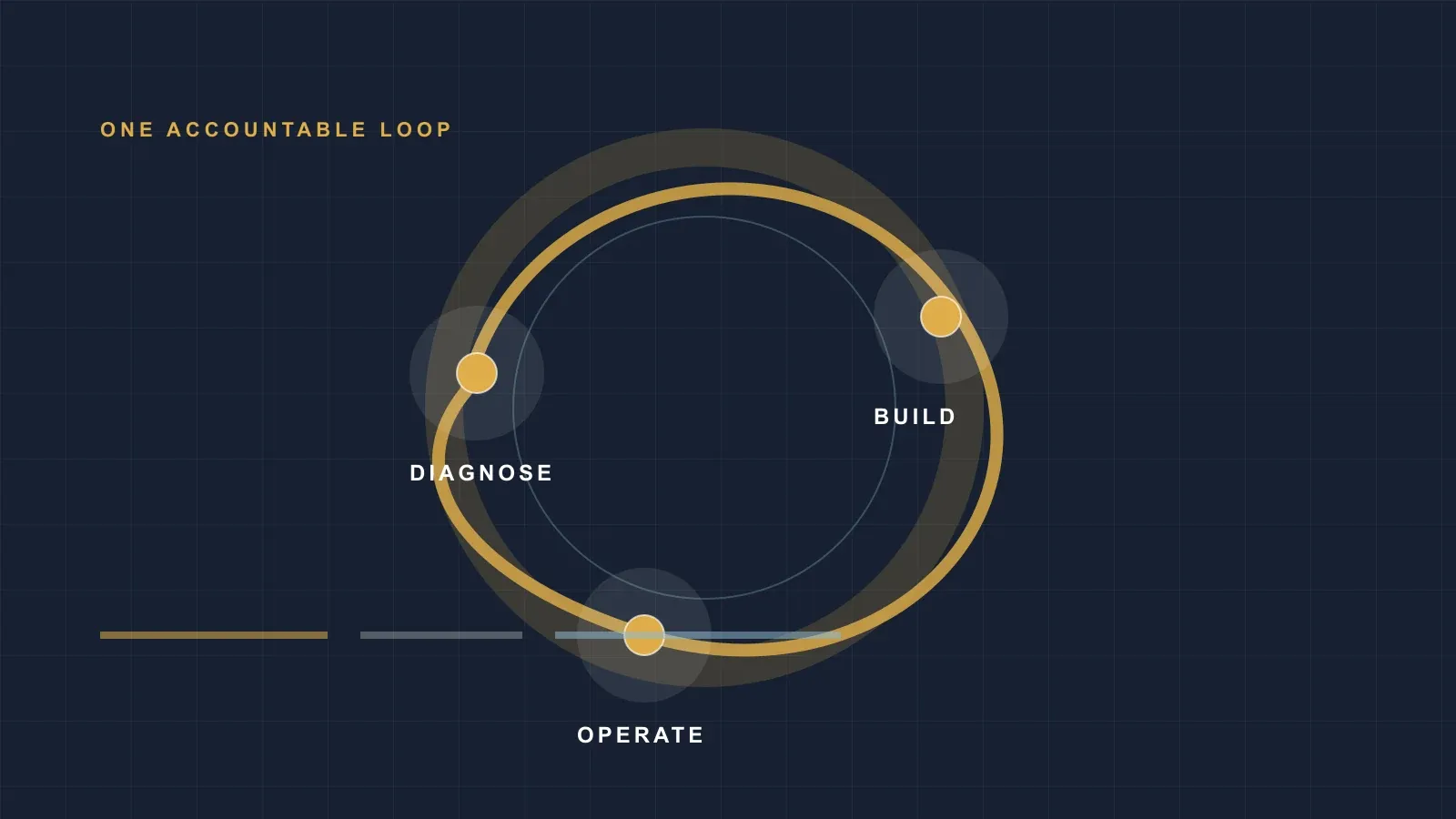
Consulting and engineering should stay connected because transformation depends on context. The people who diagnose the business problem must understand the architecture, and the people who build the system must understand the operating model. When strategy is handed off to delivery, decisions lose context. When engineering works without strategy, teams can ship technically correct systems that do not change the business outcome. Hive Vault Arc was built around the opposite belief: strategy consulting, AI engineering, software, cloud, and managed operations should move in one accountable loop.
The Handoff Problem
The common transformation model separates the work into phases owned by different teams. A consultant diagnoses the situation and leaves a deck. A software agency receives a scope and builds what was written. Operations inherits the system after launch and discovers the edge cases that were never designed into the plan.
This is not a criticism of consultants or agencies as people. It is a structural problem. Each team can do its part professionally and still leave the client carrying the burden of connecting everything. The more handoffs there are, the more context has to survive through documents, meetings, assumptions, and memory.
In real transformation work, that context is the work. Why a workflow exists. Which exception matters. Which department will resist a change. Which data field is politically sensitive. Which metric leadership actually cares about. Those details are easy to lose when diagnosis, architecture, build, and operations are treated as separate worlds.
What Gets Lost Between Strategy And Delivery
- The original business constraint that made the project necessary.
- The reason a feature mattered to the operating model.
- The edge cases heard during discovery but not written clearly into the scope.
- The organizational constraint: approval rights, team capacity, incentives, or adoption risk.
- The real success metric behind the work.
- The operating responsibility after launch.
- The future roadmap logic that explains why some choices matter more than others.
Strategy without delivery becomes a deck. Engineering without strategy builds the wrong thing beautifully.- Hive Vault Arc perspective
Engineering Needs Strategy
Good code is not enough. Architecture decisions are business decisions because they decide how teams will work, what data will be trusted, which processes can scale, and where future cost will appear. A data model can either clarify ownership or encode confusion. A user interface can either support adoption or quietly push staff back to spreadsheets and WhatsApp side channels.
Infrastructure decisions also carry business consequences. Reliability, security, cost, integration depth, and observability affect whether a system becomes part of daily operations or remains a fragile project. AI systems make this even more important because prompts, models, workflows, and human escalation rules need ownership after launch.
Engineering teams need to understand the operating logic, not only the feature list. Otherwise they may ship a system that meets the scope but misses the transformation.
Strategy Needs Engineering
Strategy must respect technical reality. A roadmap that ignores data quality, integrations, security, user adoption, performance, and operations is not a transformation plan. It is an intention.
The best strategy work is informed by delivery knowledge. It understands which dependency will slow the project, which system cannot be replaced immediately, which workflow should be simplified before it is automated, and which capability should be built now because future phases will depend on it.
This is why Hive Vault Arc works as a technology transformation partner rather than an advice-only consultancy or build-only software team. The plan should be shaped by the people who understand what it will take to make the system real.
The ARC Loop
ARC is Hive Vault Arc's public delivery model: Assess, Re-engineer, Command. It is not a sequence of departments. It is one team moving through three modes of responsibility.
Assess
Assess means diagnosis: business workflow, operating model, architecture, data, risk, constraints, and roadmap. The output is not only a recommendation. It is a shared understanding of what must change and why.
Re-engineer
Re-engineer means building the AI, software, cloud, integration, and process layer that supports the target operating model. Delivery stays connected to the original diagnosis, so implementation choices serve the business outcome.
Command
Command means managed operations after launch: monitoring, maintenance, workflow tuning, reporting, and iteration. This is where transformation becomes production reality rather than a project that ends at deployment.
What Clients Should Look For
- Does the partner understand the business workflow, not only the requested software?
- Can the partner explain architecture in business terms?
- Will the people who scope the project stay involved during delivery?
- Is there an operations plan after launch?
- Are metrics defined before implementation?
- Is ownership clear when something breaks?
A serious partner should be able to move between consulting language and engineering reality without losing the thread. They should understand the buyer's constraint, the user's workflow, the system architecture, and the operating responsibilities that continue after go-live.
Closing Point of View
The future belongs to firms that can think and ship in the same loop. H.V.A was built around that belief: advise, build, operate, and keep learning from the system after it goes live.
Transformation does not fail only because of weak ideas or weak code. It fails when context breaks between teams. The work is strongest when diagnosis, architecture, delivery, and operations stay connected until the system is actually working in production.
Questions leaders ask before AI
Why do transformation projects fail at handoffs?
Handoffs often lose the business context behind technical decisions. When discovery, architecture, delivery, and operations are separated, teams may optimize their own part while the overall operating outcome drifts.
What does it mean to connect consulting and engineering?
It means the people shaping the strategy understand the technical path, and the people building the system understand the business workflow. Scope, architecture, data, user experience, and operations are treated as one connected system.
How does ARC reduce execution drift?
ARC keeps the same accountable loop across Assess, Re-engineer, and Command. The original diagnosis informs delivery, and production operations feed learning back into the system after launch.
What should a business ask before hiring a transformation partner?
Ask whether the partner understands the workflow, can explain architecture in business terms, will stay involved during delivery, defines metrics before implementation, and has a clear operations plan after launch.